
“Jeszce Polska nie zginęła”
Above is the first line to Poland’s national anthem. It means “Poland has not perished yet”. This declaration seems less true every day, as the country appears to be spiralling into an undemocratic one-party state.
Extremist groups are on the rise all around the world. From the dire situation in Orban’s Hungary where democracy does not exist, to milder scenario’s in Britain, Spain and Italy where extremist and populist governments are on the move.
This article focuses on Poland. While in a less extreme situation than Hungary, my dual nationality compelled me to investigate the situation in Poland and my own family history.
My great, great uncle fought against the Nazis as member of the Partisans in WW2. Then came Communism; other relatives proudly fought with Solidarity.
Having defeated Communism, Poland was internationally admired and respected for successfully establishing democracy and later for achieving economic prosperity (currently being the 6th largest economy in the EU). Poland was painted as the poster child of post-Communist success. I feel a great sense of pride learning about the resilience and accomplishments of my ancestors, and a greater national pride looking at all Poland has overcome and how it has flourished since warding off the endless invasions.
Yet, observing Poland’s present-day situation feels like peering down memory lane as the country is decreasingly democratic, and a depressing future ominously awaits. This time the threat comes from within.
This article recounts the recent events in Poland, aiming to explain how the Law and Justice Party (who I will refer to as PiS) came to power in 2015, then analysing threatening moves of theirs since winning, proceeding to look at the alarming ways in which they won the recent 2020 election. Finally, we explore the different paths the country may take, ending on an exploration of alternative routes which might enable Poland to avoid a gloomy future.
One may ask what the relevance of such a blog is. In the age of globalisation, political relations are key and will affect each country somehow. Poland is of close geographical proximity, and while we may be leaving the EU, their issues will remain relevant to us and Britain will not live in isolation to the political climate of the world. Regardless of whether you deem Poland of particular relevance, the situation over there is a drop in an ocean of rising extremism. If the plague of extremism is not stopped in Poland, it will spread to a country that is immediately more relevant to us, or even make its way to Britain.
If through the analysis of the situation in Poland more of us are able to understand how these extremist groups gain power in our current age, then we are better equipped to combat them in the future and secure the future existence of democracy and freedom.
Victory
In the 2015 elections, the two parties in greatest competition were the ‘Law and Justice Party’, who are also referred to as PiS, and the Civic Platform party. PiS is a national conservative and right-wing populist party in Poland. Civic Platform is a liberal-conservative party. Prior to the elections, Civic Platform had been in power.
The first round of elections gave the PiS (the Law and Justice party) 37.6% and since there was no majority, a second round of elections was necessary.
Duda marginally won with a result of 51.2%: 48.8%. In such a modern and forward-thinking country, the victory of this right-wing party seems (to us on the outside) random and unexpected.
Below I list several ways the Party managed to gain a majority.
- The people who were left behind
Most of Poland flourished after Communism fell. However, during the transition period, a certain percentage of society did not benefit. Whether it be those who were lazy, uneducated or simply comfortable with the previous regime, they did not prosper in the Post-Communist Poland and ended up living in poor conditions.
Many governments in the last 30 years ignored this group, allowing resentment of the present government and somewhat nostalgic sentiment towards Communist times build up. These people suddenly became a very powerful electorate.
Recognising this, Law and Justice appealed to them by promising improved living conditions for this sector of society. For the first time in a few decades, this group was given attention and hope for the future. Law and Justice immediately gained approximately 15-20% of votes, giving them a substantial layer to build up from.
2. Role of the Church

The Church were very helpful in fighting Communism. However, once Communism collapsed, the Church did not want to take a step back and instead sought to continue playing a political role. Thus, the Church decided to publicly support PiS, with the knowledge that PiS would support them back.
Poland is a religious country, there being 33 million Catholics out of a population of 37 million, making it approximately 90% Catholic. The church is particularly influential in those communities in remote areas, thus encouraging devout Catholics to vote for the party. There is already a split between urban and rural mentality, with liberal ideas infiltrating into cities more and conservatism ruling the countryside. The fact that the Church support PiS broadens this gap and decreases the likelihood of those in the countryside voting for the opposition.
As such, the church’s public support of the party added a few more percent towards PiS’s majority.
3. Addressed older society
In their campaign, they appealed to the older population.
They did this by promising to reintroduce past practices, such as the former approach to education. The age group category of 65+ were familiar with this and thought it might help their offspring and thus voted for PiS. Such a small and trivial promise gained them roughly an extra 3%.
4. 500+
This was a program they promised to introduce in which parents would get 500 złoty (equivalent to £100) per child each month until they were 18. It was proposed in order to encourage people to have children to improve the demographics of society.
While in practice this program is leading to a huge budget deficit and minimal increase in birth rates, it was attractive as people receive tax free money and in this way attention was gained from those with children.
This added another increment of support towards their majority.
5. Young generation
While majority of the younger generation do not support PiS (as younger people tend to hold more liberal views in Poland), a fraction of young people did for the following reason.

In the age of social media, it is an open world in which one can turn on their phone and see how others may have a better lifestyle than them. This leads to comparing, and hence feeling pitiful about your own life.
PiS grasped this sentiment and said to the young people (and their parents) that if they kept voting for them then they would diminish inequality between east and west e.g. between Poland and Germany. This is pure propaganda in which no real action was put forward to close the gap, but they still gained support by recognising a source of raw emotion and weaponising it.
6. Weak opposition
At the time of the election, Civic Platform had been running the country for 5 years and the national mood was one of desiring change. Civic Platform did not step up to the challenge and did not produce attractive counter proposals. Instead, Law and Justice took the reins and managed to scrape a majority.
Accumulative majority
As such, by the end of the campaign their supporters came from many sectors of society by appealing in niche ways: those who did not benefit from the end of Communism; several devout Catholics; some senior members of society nostalgic of old institutions; that large group who was drawn to the 500+ program; and, a fraction of the younger generation.
Their support is not large in one particular sector of society, but rather their win was due to them cunningly appealing to several neglected groups, accumulating a marginal victory in the second round of elections.
Concerning moves
Once in power, they started to make bold and concerning moves. This involved attacking the judicial courts and rule of law, taking control of state media and other state institutions, and employing anti-LGBT and anti-Semitic rhetoric. Each damaged (and continues to damage) the prosperity of the country in their own ways
Attack on Judicial courts
Majority of this happened 5 years ago when they first came to power, and ever since they have continued to chip away at the power the courts once held, transferring it to the party and floating away from democratic practice.
Firstly, the Party combined the function of the Minister of Justice (a member of PiS’s government) with the general prosecutor (previously meant to be an independent of the party in power). This meant that the politician appointed (by the party) to the position of minister of Justice had direct control over and can influence prosecutors all over the country. This means they are in control of who does and does not get punished for breaking the law. i.e. if a member of PiS breaks the law, the might not be held to sufficient standards of law.
Secondly, the party altered the law in 2018 to allow the lower house of parliament (which it controls) to choose the members of the council that appoints judges to the Supreme Court. The Supreme Court is the body in charge of supervising the adjudication in general courts and military courts. Although the Supreme Court fought back, approving a resolution that declared judges chosen by the new council were not independent and did not conform to the requirements of being a judge under the Polish constitution or EU law.
The European Commission opened a three-step inquiry into whether the Polish government had violated the union’s democratic norms, resulting in the resolution passing with a vote of 513:142. Czarnecki (member of PiS) called it “coarse and vulgar”, rejecting the verdict entirely.
Finally, they have started influencing the constitutional court, who are meant to be wholly in line with the constitution. As such, the constitutional court has become a fictional body as they have appointed their own selected people.
Essentially, the rule of law increasingly ceases to exist. When the courts are not independent from the government it opens up the door to corruption and biased. It is antidemocratic and thus signals potential separation from the EU. Even worse, such changes in law suggest that PiS will abandon democracy in all senses and lead Poland into becoming a one-party state.
Taking over Media
Since 2015, PiS have greatly taken control over state media and television. The Party changed the law so that The Treasury Minister (member of the Party) has the right to hire and fire the broadcasting chiefs. This role was once in the hands of an independent media supervisory committee. Duda claimed he did this as he wanted to make the media “impartial, objective and reliable”. Realistically, it was because some parts of the media had been against Law and Justice and published pieces outing the Party.
However, this change has not resulted in objectivity, but allowed the Polish equivalent of the BBC (Telewizia Polska) to become an outlet for outright propaganda and misinformation in order to support party agenda. The Media is supposed to be a source of differing views for the population, particularly the state Media which should be independent of the government. Having control over the Media allows PiS to publish misinformation that supports their agenda, warping people’s perspectives and eventually gaining misled support. Secondly, the media can no longer act as a rallying point for opposition and dissent, giving the opposition a minimised platform to publish their views and hence allowing PiS to enjoy an internally undisputed rule. This action will become even more significant later when discussing the nature of the 2020 election.
In a technological age, this may not seem too threatening as people can freely publish online, whether it be on social media or an independent news forum. In urban areas this attitude may suffice, as people can select from a range of international news outlets. However, the issue lies in the fact that the rural population are rarely in tune with as many outlets. Surveys estimate that roughly 50% of residents in the Polish countryside get their news exclusively from the national broadcast (i.e. Polska Telewija). If this is the only news outlet they engage in, they will find it difficult to identify the misinformation and thus will more likely take the propaganda at face value. Thus, support for PiS increases and the gap between urban and rural sentiment increases as those living in rural areas live oblivious to the damage PiS is doing to their country and continue to vote for them, initiating a positive feedback loop.
“LGBT is not people, it’s an ideology”, President Duda

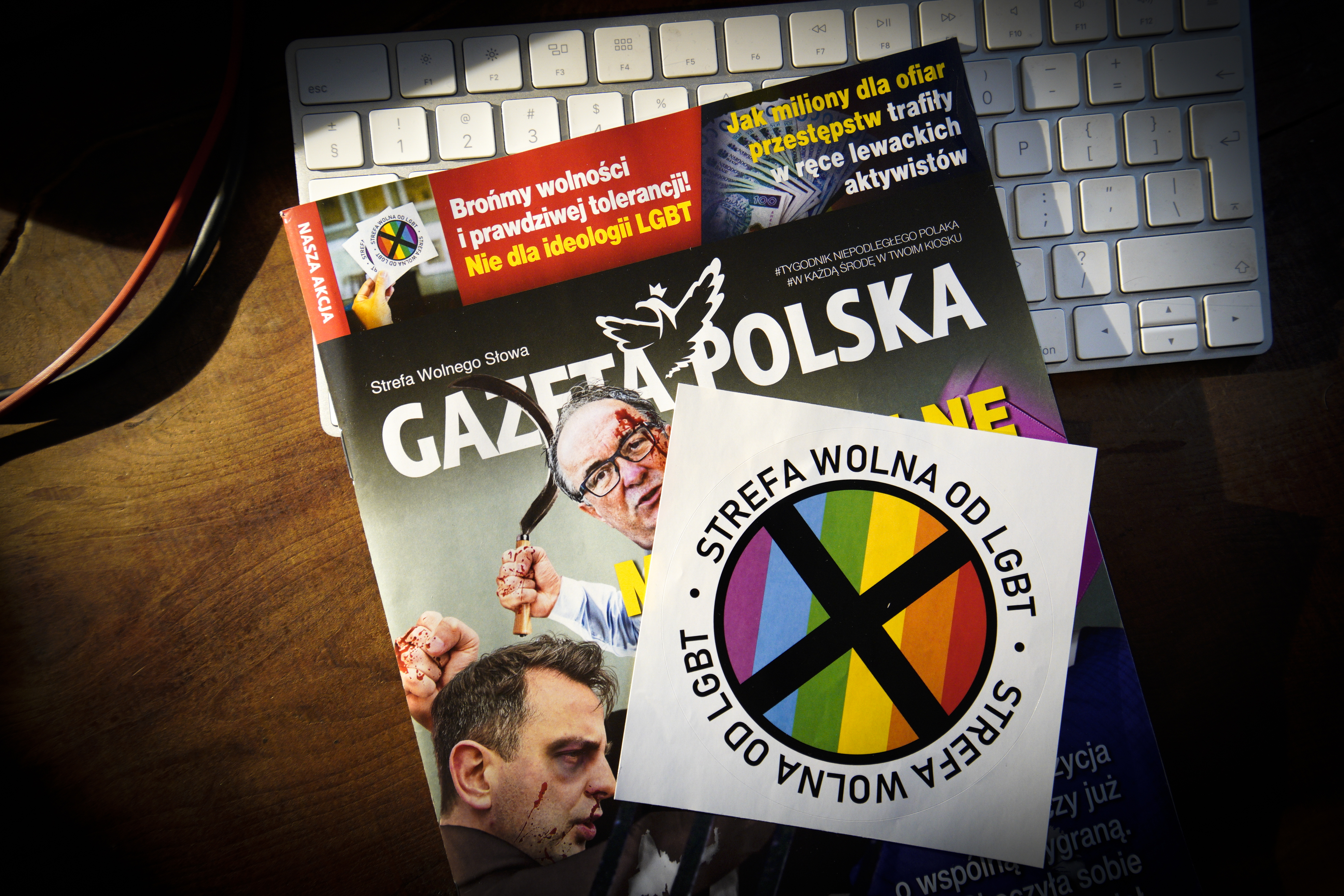
In 2015, PiS adopted an anti-LGBT sentiment during their campaign and it has endured. This aligns with the Catholic church’s belief that homosexuality is not part of natural order. In a sermon, The Archbishop of Krakow even described homosexuals as a rainbow coloured “plague”, replacing the “red plague” of Communism. The Polish government applauded the statement later. Joachim Brudzinski, a conservative politician and member of parliament, tweeted that “Poland without LGBT is most beautiful”, including an image of Jesus and eggs in a bird’s nest, he said it was a bird family “realising God’s plan”. More recently, Gazette Polska (a national weekly) printed “LBGT free Zone” sticker for its readers. Moreover, as of June 2020, some 100 municipalities (encompassing a third of the country) have adopted resolutions which have led to them being called ‘LGBT free Zones’.
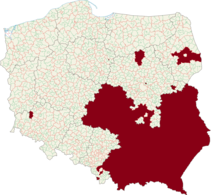
The Zones are unenforceable and mainly symbolic. Nonetheless, they are creating an enemy within the country to unite against. We have seen this kind of tactic in Hitler’s Germany, Stalin’s Russia and in a Brexiting Britain as politicians demonised immigrants during their campaign. It is dangerously familiar and often has dire consequences. As Trzaskowski (leader of Civic Platform) said (responding to Joachim’s tweet mentioned earlier) “if you use the words ‘Poland without someone’– and it doesn’t matter who – that is dividing Poles, and we have had enough of dividing Poles.”
Apart from the fact that such views are from a bygone era, them pumping out such ideas has two main harmful effects. Firstly, more violence is incited and discrimination against perpetuates. In an age of social media, tweets can be directly harmful, especially when made by figures (like politicians) who have a significant platform. This is because when influential figures express such views, those in the population already holding them feel validated and thus more comfortable to act on them. For example, when Boris compared Muslim women to “letter boxes”, a significant rise in hate crime against Muslim women was reported.
As such, due to the platform this hate is being pumped out at, the LGBT community are subject to an increase in unjustified harm and criticism and segregated for something that they cannot control.
Secondly, great harm is done to the international reputation of Poland. Investors lose respect for the country due to the connotations such views have of backwards progress and are less likely to invest firstly out of principle, and secondly due to the fact they fear the future of the country is not stable and is unpredictable. This jeopardises future growth of the economy, having a domino effect and harming the living conditions of Polish citizens in the future.
Recent undemocratic/unfair election
The 2020 presidential elections that occurred at the beginning of the Covid outbreak resulted in a clear win for Duda, leader of PiS.
Even the fact PiS had a crisis boost in popularity made the elections unfair. However, there is serious debate over whether the actual elections in Poland were democratic, let alone fair. Some are asking for the results to be declared invalid for the following reasons:

- Ban on public events.
Due to the outbreak of Covid-19, there was a ban on public events. This made campaigning very difficult for the opposition, while Duda had relative freedom to conduct public meetings and press conferences. This meant an immediate advantage for PiS, eradicating the chance of a level playing field.
2. Control of media
As mentioned earlier, PiS took control over the state media. This control gave them the perfect opportunity to pump out propaganda. As mentioned earlier, most people in the countryside only engage in state run media. Thus, PiS had unfair leverage over Civic platform as they were able to advertise their rhetoric and pump out propaganda.
3. Unconstitutional
There were changes made to the electoral laws. As the election was fast approaching, the party introduced postal voting. Firstly, the constitution forbids any changes to the electoral law later than 6 months before the election. Secondly, the constitution provides direction as to what to do in such a scenario. Thus, the constitution was disobeyed in two ways.
Piotr Buras (from the European Council on Foreign relations) said, “there is no legal basis for the election to take place”.
4. Postal voting
Moreover, arranging postal voting so quickly would prove difficult and leave much room for interference. Human rights watch said:
given the unprecedented nature of such a full-scale mail-in voting in Poland, and the extremely short time frame, it appears very unlikely – if not impossible – that the process will guarantee fairness and transparency’.
5.Poles living abroad
There was worry as to whether those Poles living abroad would be able to participate in the election. Recent checks showed these concerns were not unjustified. In Britain, over 30,000 ballots (16.6%) went missing. Poland’s foreign minister blamed the British Post Office and voters themselves for the issues, which seems awfully convenient considering Duda was unpopular in Britain (32,067 votes for him compared to the 112,207 votes for Civic Platform leader Trzaskowski). In Germany, 11,500 ballots did not arrive at the consulates on time so were not counted at all.
Overseas 520,000 people registered to vote before the election but only 415,951 ballots were counted. There is speculation as to whether the government has interfered in order to minimise the number of voters abroad as international citizens of Poland are more likely to be against them. While not to do with Polish citizens living abroad, there were alarming results in several nursing homes, where Duda had won 100% of the vote.
These irregularities cumulatively give reason for great concern and suggest PiS likely interfered with the election.
What the future looks like
There a several routes the country can take:
- One- party state
The worst thing that can happen is the party wins a constitutional majority and are legally given absolute power. The means by which they achieve this would likely be harshly undemocratic, and such action does not look unlikely given the violations they committed in the recent election and their attack on the courts previously.
Once they have this constitutional majority, Poland becoming a one-party state seems inevitable, and I need not spell out the consequences of this kind of future as all one needs to do is look at a History book on 20thCentury Europe.
2. EU steps in, PiS backs down
However, if Europe get involved, the tides may turn. Currently, PiS see the EU as a piggybank, funding Poland regardless. Yet, due to the antidemocratic way Poland have been operating and the violation of the Union’s values, the EU can retract funding due to the fact EU values are not being upheld. This would put economic pressure on the country, who will need aid after the stagnancy of lockdown begins to take its toll on the economy. The economic sanction could be conditional on whether PiS start practising EU values or amend previous antidemocratic acts, forcing PiS to comply. Another sanction might be suspending voting rights, pressuring them into submission through sheer humiliation. If forced into submission, they may go back on previous wrongdoings (e.g. control of state media and the judicial courts) in order to appease the EU. Regardless of the intention of PiS, Poland would be forced to revert back to more democratic practice and hence upkeep the Union’s standards.
3. Civic Platform make a comeback
The opposition, Civic Platform, might find a way to appeal to the citizens of Poland. In the case that the EU does impose economic sanctions, hardship for the citizens will follow. If voting sanctions are enforced, international humiliation will follow. If Civic Platform have a way of reaching the electorate and convincing them that PiS is not benefiting them and are even detrimental to their wellbeing, then great change is possible.
Concluding thoughts
As you can see, the situation is not ideal. It saddens me to see the country take such a turn for the worse. It is essential that the EU steps in now, not only to save Polish citizens from entering another antidemocratic era but to prevent cross contamination of extremism and authoritarianism. If PiS suffers consequences for not practising EU values, other extremist groups in Europe will be more hesitant to go against these values. However, if nothing is done and PiS are left unbothered, a gloomy future awaits for Poland and other global citizens as extremist groups around the world who watch on are given the confidence that if they act no consequences will follow.
 Stamp’s Post