Reading about denunciation under the Stalinist regime. Scrolling through your Twitter feed. History repeating itself.
Sensationalist exaggeration? Completely. We are not quite there yet.
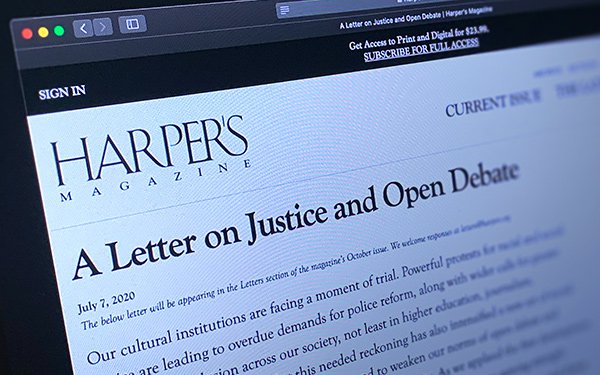
Nevertheless, many people are arguing that the Cancel Culture has gone too far and freedom of speech is under threat. Particularly those 150 artists, writers and academics who signed ‘the letter’ defending “the free exchange of information and ideas”, published in Harper’s Bazaar last Tuesday. Their key message being that we must be allowed to post opinions (that may seem controversial or wrong) without being wiped off the face of the earth.
Others state that the term ‘Cancel Culture’ is only employed by the powerful and privileged to discredit those trying to protect vulnerable minorities by holding people accountable for their unacceptable behaviour. They argue that some people should no longer have the opportunity to air their views.
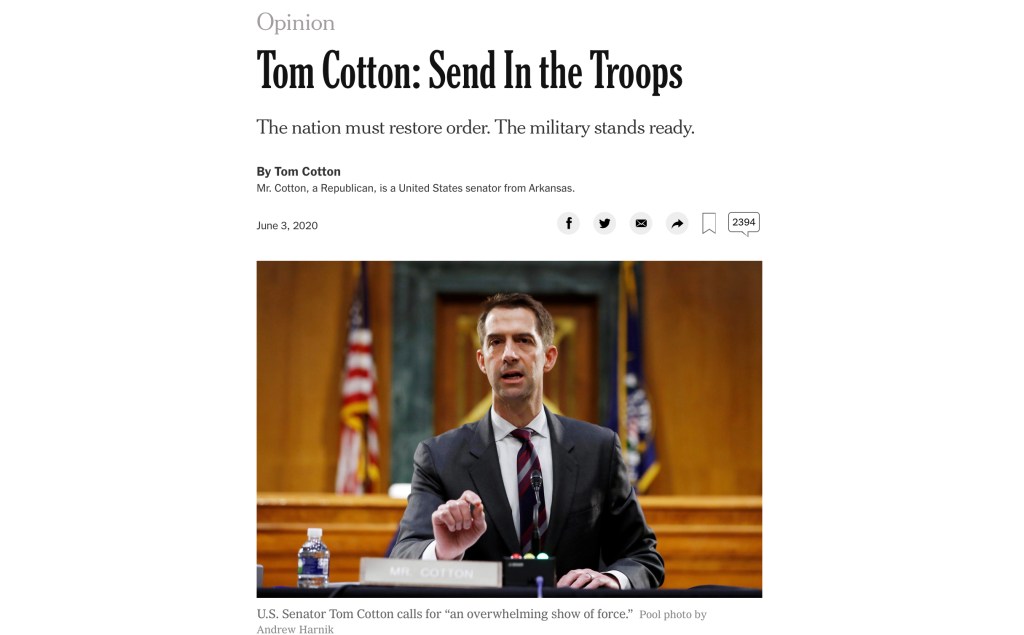
James Bennet, the highly esteemed op-ed (a written prose piece typically published by a newspaper or a magazine which expresses the opinion of an author not affiliated with the publication’s editorial board) editor of the New York Times, had to resign. He was ‘cancelled’. This was because he carelessly commissioned a piece by Senator Tom Cotton that called on Trump to use “overwhelming force” to crack down on the BLM protests (i.e. deploy the military). Cotton made several factual errors when referencing historical episodes in which the military were deployed, and painted a distorted picture that the police were the major victims of violence in the BLM protest (when in fact far more civilians have been killed during the riots than police)
Some were grossly offended that Bennet would allow such a thing to happen and were happy to hear he lost his job. Others believe not only was it an extreme reaction to a careless mistake, but by firing him the NYT bowed to Cancel Culture – to the detriment of free speech. The event has sparked debate over whether people like Cotton should be given the opportunity to air their views on news platforms, and whether ‘Cancel Culture’ will truly signal the demise of freedom of speech.
Let’s consider the logic on each side.
The voice of those who fear ‘Cancel Culture’ has gone too far
Cancel culture (as discussed in this piece) refers to the cultural boycotting of an individual/ organisation after having posted/ expressed views that are deemed offensive or unacceptable. The consequence usually being that person facing punishment e.g. being made to resign.
I do not think that the 150 people who signed Harper’s letter are advocating for bigoted behaviour. I am sure that the vast majority of them were relieved when Katie Hopkins (along with her illogical, crude, offensive and stupid comments) was permanently banned from Twitter.
Rather, they argue that it has gone a step too far in that it is beginning to attack anyone who holds a contradicting or alternative stance, deleting them from the conversation and stating their whole view is just plain wrong. It might be wrong, but by infringing their rights to freedom of speech the culture paints the colourful marketplace of ideas grey. This has negative impacts on our society.
First negative impact: by not airing the view, we are not given the opportunity to make the truth livelier and clearer.
Look at what John Stuart Mill said about the freedom of speech:
“...the peculiar evil of silencing the expression of an opinion is that it is robbing the human race. If the opinion is right, they are deprived of the opportunity of exchanging error for truth; if wrong, they lose, what is almost as great a benefit, the clearer perception and livelier impression of truth produced by its collision with error.”
This means that right or wrong, all opinions should be aired (assuming that it is possible for an era to have some sort of truth). If right, the audience has gained insight and can come closer to truth. Further (and more noteworthy in regard to the airing of controversial opinions) is the fact that if a wrong opinion is brought forward it prompts a debate, in which (due to the necessity of employing rhetoric to defend the ‘right’ view) the truth is explored and more deeply understood. Instead of an undisputed “dead dogma”, a “living truth” prevails and more people truly comprehend the logic and argument behind it. As Harper’s letter put it: “…the way to defeat bad ideas is by exposure, argument and persuasion”.
Take Tom Cotton’s op-ed. His argument was littered with inaccuracies when referencing historical episodes. The inaccuracies, and unfounded and illogical reasoning were identified subsequently. Consequently, more people became aware of this misinformed perspective and divisive reasoning, and consequently have a greater understanding of the ‘truth’.
The argument goes that if the piece was not published then this process would not have occurred and fewer people would understand why this man’s argument is invalid.
Second negative impact: the general population who are observing these events unfold (e.g. of James Bennett) become afraid of expressing mildly controversial opinions so that they might avoid being ‘cancelled’, and in the blight of social media rage and hysteria, their careers and lives damaged.
Whether or not they would lose their job if it played out in reality becomes irrelevant, as people are afraid to express their opinion, and instead opt for sticking to ‘safer’ opinions, or not talking at all and shutting themselves off from the discussion. The phrase “I think *insert any mildly/strongly controversial opinion*, but would/could never say it these days” is increasingly prevalent behind closed doors of homes, workplaces and academic institutions. As such, a kaleidoscope of ideas is morphing into a space in which an undisputed status quo reigns supreme as the only publicly acceptable version of the truth.
Cancel culture shuts down the conversation and opportunity for debate, not allowing more people to understand the truth. Also, it repels a greater number of the population from initiating future debate out of fear of disproportionate consequences.
Third negative impact: liberals adopt a ‘bury the head in the sand’ mentality and due to the refusal to publish or fear of publishing alternative views, they remain unaware of the views of a significant proportion of the general public until a sudden rupture reveals true public opinion, with dramatic and negative consequences. Ruptures such as Donald Trump being elected as president, Britain voting Brexit.
Again, we look at Cotton’s article in the NYT. These opinion pieces are supposed to represent a range of beliefs from around the country. In this case, (whether we like it or not) a great proportion of America takes Cotton (along with his rhetoric) seriously. The point is not to take it seriously ourselves, but to acknowledge that many do in fact take it seriously. We must publish it so that we can dismantle his argument and take a step towards disproving the logic so that perhaps some former supporters of Cotton might see the light. It is all part of a process of breaking down the bad ideas where necessary.
Thus, we should avoid perpetuating Cancel Culture as it is necessary to address all views and discuss the rhetoric behind them so that growth is possible, revealing their foolishness where deserved instead of deleting them from the conversation entirely.
“I disapprove of what you say, but I will defend to the death your right to say it” (Evelyn Beatrice Hall, ‘channelling‘ Voltaire) seems a fitting summary of this viewpoint.
The voice of the Other Side
- The term itself – a myth?
Those facing criticism for participating in ‘Cancel Culture’ claim that this is simply another term created by those in power, to discredit and devalue the work of people trying to protect vulnerable minorities. Terms such as ‘political correctness’ and ‘social justice warrior’ are said to bear the same purpose.
Flora Gill in The Times described it ‘like a patchwork monster invented to scare children’. They claim that the concept is a myth, that people are not literally being ‘cancelled’ but simply being held accountable by an online community for uninformed statements. Essayist Sarah Hagi wrote “I’m a black, Muslim woman, and because of social media, marginalised people like myself can express ourselves in a way that was not possible before. That means racist, sexist, and bigoted behaviour or remarks don’t fly like they used to”. So the question appears whether this is simply a term to discredit those holding people accountable, due to intimidation of their new found power on social media?
Looking closer at why the term is considered by some as inaccurate: when people are ‘cancelled’, they generally face a few weeks of criticism and then life returns back to normality anyway. J.K. Rowling has faced the Twitter storm and a few publishers withdrawing support due to her alleged transphobic comments, but this has not materialised into her entire career going down the drain. Furthermore, it is argued that cancel culture has been alive for years before this label was put on it. Tabloids and newspapers have been calling people out for their behaviour and comments for ages, but this time it is coming from the general public on social media.
James Bennet, an esteemed editor, did not complete his job properly and caused damage to the reputation of the Times. He had to resign and will likely face a blow to his career for a short while, but normality will probably return sooner rather than later. Mistakes are mistakes regardless of intention, and, consequences follow.
.
So it seems that a kind of moral panic is being whipped up, installing in people’s minds the idea of an issue that is not really there.
Furthermore, those defending ‘Cancel Culture’ argue that the comments being flagged are being discussed and their rhetoric dismantled in a manner in which Mill would have approved, not just proclaiming it wrong.
If ‘Cancel Culture’ does exist, it in no way exists in such a form or to the extent that is being suggested by some.
The Harm Principle
Mill did have one rule that limits freedom of speech: The Harm Principle. Mill said:
“… the only purpose for which power can be rightfully exercised over any member of a civilised community against his will, is to prevent harm to others”.
It is sometimes difficult to pinpoint what constitutes ‘harm’. Mill illustrates his definition with an example about corn dealers:
“An opinion that corn dealers are starvers of the poor… ought to be unmolested when simply circulated through the press, but may justly incur punishment when delivered orally to an excited mob assembled before the house of a corn dealer”
This translated to the idea that freedom of expression should not be allowed if it is inciting violence and likely to cause harm.
In the case of the publication of Cotton’s piece:
- Tom Cotton is the one airing the opinion to the mob,
- the BLM protestors are the corn dealers being harmed by the angry mob,
- the excited mob is equivalent to the police on the streets who read the article and,
- The Times are the ones delivering it orally, allowing this to take place.
Drawing this parallel, we might be too optimistic in assuming that the common reader of the NYT will dissect Cotton’s argument and identify errors. Instead, his highly distorted account of the BLM protests and of historical episodes is taken as the truth by many and validates police in America using extortionate force on civilians. The point being that there is a time and place to publish his argument, and it is not right to amplify this voice amidst a time of civil unrest where the rhetoric can be use as ammunition for those validating unlawful and harmful behaviour.
Mill’s ‘harm principle’ might be regarded doubly important due to the age of social media and the press having great influence. In the past, we’ve seen how when words inciting violence are posted on a wide reaching platform, harm directly follows.
E.g. Trump lamented that “other countries” are allowed to shoot migrants; “other countries stand [at the border] with machine guns, ready to fire,” and “it’s a very effective way of doing” things. Shortly afterwards, we saw a mass shooting in El Paso, perpetrated by an author of a manifesto about an immigrant “invasion”. The UK’s current Prime Minister, when Foreign Secretary, compared women in a burqas to letterboxes. Following this, a rise in hate crimes towards Muslim women was reported, with perpetrators relying on Mr Johnson’s words.
James Bennet was ‘cancelled’ by the people who identified this pattern, and want to hold him accountable for this careless mistake so that less people will make the same mistake in the future, with the wider goal of preventing serious damage done to vulnerable minorities I.e. the corn dealers/ the BLM protestors.
Final thoughts
Regarding Cotton’s piece, the NYT could have published it, but simultaneously published comment on the factual and other flaws in his piece. This would not be the NYT practising ideologically fuelled censorship, but the use of logic and reason in order to dismantle dangerous ideas in hope of reaching and convincing Cotton’s supporters that his argument is flawed. There would be no ‘burying your head in the sand’, nor outright amplification of misinformed views.
The bottom line is ’Cancel Culture’ is multidimensional, straddling other topical issues such as what hate speech is, safe spaces etc.
My view is that ‘Cancel Culture’ is present, but not to the extent that is being made out amidst a moral panic. The good thing about this sudden discussion about a perceived ‘Cancel Culture’ is that it has encouraged us to evaluate what we value as a society, and acknowledge that we would not want a future without controversial opinions. It has raised essential questions about who should and should not be given a platform, also warning us of our responsibility to question what we read and not accept it at face value.
Whether Cancel Culture exists or not, we can learn a lot from this discussion.
 Stamp’s Post