Categories
History

The British Problem

With the sentiment of Scottish independence looming large, the matter of Britain is as pressing as ever. From this arises the question how much the ‘matter of Britain’ has had an impact on history? Looking back at 17th century Britain, we see that these nations have never lived in isolated bubbles and an appreciation of this might provide us with some avenues through which to look at our current affairs. Alongside the fallout of Covid and Brexit, exploring this historical episode stimulates us to consider whether (and how) England’s history once again be impacted by a new push for Scottish Independence?

The following article transports us back to 17th century Britain, seeking to reframe the typically Anglocentric history by showing the interconnectedness of the warring period of 1637-51.

Should the English Civil War properly be seen as just one of the wars of the three kingdoms of the mid-seventeenth century, all stemming from the so-called “British Problem”?

The English Civil War has taken centre stage in the history of Britain’s warring period of 1637-51. The Bishops’ Wars and Eleven Years’ War have been portrayed more as background events in the story of the English Civil War, while England and its internal divisions have enjoyed a spotlight in explaining its causes[1]; rather than investigating the unifying causes of all three wars. Each kingdom was member of a multiple monarchy ruled under Charles during this period. Thus, the consequences of the English state trying to rule in three kingdoms with different religious and political makeup, with a particular policy of unifying these three kingdoms, is an avenue worth exploring in explaining why each of these wars occurred. This we define as the “British problem”. As such, we will consider the ways in which the “British Problem”, as defined, contributed to the Bishops’ Wars, the Eleven Years’ War and the English Civil War, subsequently considering whether the English Civil War deserves the significance it has been attributed.

England’s hegemony

Let us consider the three kingdoms in the order armed resistance against King Charles I arose, starting off with the Bishops’ Wars in Scotland, 1637. These wars were fundamentally a result of England’s failed policy of securing cultural hegemony over Scotland. Charles wanted to align the Scottish Church with the English Church by promoting Laudian policies. For example, he arbitrarily introduced a new set of Canons and a new Prayer Book in Scotland which was in line with English practice. Firstly, they ardently opposed these adaptations as they were seen as too synonymous with Catholicism. Moreover, Charles’ policy promoted the role of the bishops in the Church[2]. Whereas, in the view of the Scots, the church should have been governed by ministers and elders. It was these qualms which they fought for in the Bishops’ Wars, made apparent by the 1638 National Covenant which pledged to oppose such “innovations”[3]. Thus, we see that the chaos that broke out in Scotland was due to the British problem as Charles had been too insistent on enforcing English religious domination over a kingdom loyal to the structures and practices of Presbyterianism.

Similarly, War broke out in Ireland in 1641 due to Charles’ desire to secure conformity within Britain. Firstly, Charles (through the Earl of Strafford) pushed to enforce Laudian practices. He also promised the Catholics that The Graces would be pushed through: a suspension of disabilities of the Catholics and the security of tenure for ‘old English’ landowners. This alarmed the ‘New English’ as they saw these Arminian policies as crypto-catholic in pairing with the Graces, as well as being alarmed at the thought of losing their land. Thus, a wedge was driven between the administration and the recent Protestant planters. Charles lost further support from the Old English and Gaelic Irish when the promised Graces never ended up getting past the Protestant administration. Simultaneously, the plantation scheme continued[4] in pursuit of political allegiance between the two kingdoms, the Gaelic Irish were grated further. Although it was not the uniformity Charles had hoped for, these actions amounted to the temporary unification of these previously divided groups in their shared hatred for the policy being pursued, resulting in the Irish Rebellion of 1641. As such, we see that once again, due to the religious differences between England and her subject kingdom (in this case Ireland) paired with the policy of the monarch that one must secure religious and political conformity across his kingdoms, war broke out. 

An interconnected state of affairs

We must also examine the connectivity of the events in Ireland and Scotland as part of the British problem. First, it is possible to suggest that the outbreak of war in Scotland was a consequence of Charles being distracted by issues in Ireland. In Ireland there was a degree of compromise in which Archbishop Ussher and Bishop Bramhall were left to battle about the contents of the canons amongst themselves because of the political infighting that broke out between Ussher and Wentworth; whereas, the Scottish canons appeared almost without warning, drawn up by a committee of bishops mostly appointed by Laud, an Arminian. The difference in treatment we observe likely occurred because of Charles being pre-occupied with dealing with the said resistance that had arisen in Ireland. The combination of the lack of compromise and the comparison to the better treatment the Irish received may have become a source of Scottish bitterness towards Charles and subsequently increased their motivation to rebel. Moreover, the problem with two kingdoms with similar motivations meant that one could watch the other closely and decide their actions having seen the reaction of the English. This is best illustrated in the Irish rebellion being viewed as a copy of the Bishops’ Wars: when one leader was captured and asked what he was attempting to do, he replied, “to imitate Scotland, who got a privilege by that course”. Thus, we see that the burden of dealing with two opposing kingdoms simultaneously would worsen the conditions in both, and the British problem proves potent in causing outbreak of war.

Moving to the final act: The English Civil War, 1642. Had it not been for the conflicts in Ireland and Scotland, the Civil War in England would have never occurred. First, it was the Bishops wars that forced parliament congregate after ‘The Eleven Years’ Tyranny’[5], since the victorious Scottish refused to accept a treaty not confirmed by an English parliament. This meant that their long list of grievances finally had the audience of the king. This summoning would turn into the Long Parliament, elevating tensions in England as Charles battled with his parliament over their demands. Successively, the Irish Rebellion of 1641 directly caused the outbreak of war in August 1642 when parliament refused to grant Charles the permission to raise an army but did so anyway. Thus, we see the British problem frontstage and centre causing the English Civil war. 

Moreover, the very existence of other kingdoms to turn to for support meant Charles was less inclined to resolve the dispute in his own. This can be seen in May 1641, when after the failure of the Army Plot, Secretary Vane thought that Charles would settle with his English Parliament, stating ‘there being in truth no other (course) left’. Instead, he was able to create a Scottish party via keeping relations with Montrose, which (in Charles’ perspective) would elevate his chances against parliament. Therefore, we may conclude that the English Civil war was triggered by the British problem both through the uprisings in Scotland and Ireland precipitating its outbreak and the fact that the presence of two other kingdoms disincentivised Charles making peace efforts in England.

However, the British problem does not account for why parliament did not support their king by the time the Bishops’ Wars arrived. First, not summoning parliament for Eleven Years’ meant the trust they had in their king had disappeared such that when he promised to address their grievances after dealing with the war in Scotland, they did not believe him. Yet, by insisting that he address their grievances immediately, they weakened England’s chance of reacting with a united front and quashing the uprising in Scotland immediately. Yet, why did parliament have so many grievances? In short, the answer lies in Charles’ handling of two key areas: religion and finance. Charles’ new religious policy to strive for conformity within his own kingdom led to the promotion of Arminian practices, which was perceived as synonymous with welcoming Catholicism in the eyes of the Calvinists and Puritans in parliament[6]. Second, because of Charles’ crippling financial situation[7] he had to take measures such as the Forced Loan in 1627 and further calling for Ship Money to be collected from inland inhabitants in 1634[8].  While the financial situation had been ameliorated [9]; he had passed both levies without parliamentary consent, which was seen as an exploitation of his prerogative power and was taken as an existential threat to parliamentary liberties – a belief which became the core of the parliamentary fight in the Civil War.

Thus, while the British problem may have triggered the outbreak of this civil war, it only heightened divisions which had already existed. Without the turbulent relationship between parliament and crown stemming from financial problems and religious divisions within England, the English civil war was unlikely to have occurred. 

The other similarity of all three kingdoms who broke out into war was that they were all ruled by Charles. Thus, we must question how much Charles is to blame for the outbreak of war. First, we may consider his choice in approach when aiming to achieve religious conformity, which emerges as a dominant theme in the British problem. It was common consensus that “religion is… the strongest band to tye the subjects to their prince in true loyalty”[10], and thus we cannot criticise his decision to push for conformity. Nonetheless, his characteristically rapid approach may be evaluated. His father, King James I, managed to deal with the divide in religion by pursuing it slowly[11], never allowing the moves to be extreme enough to give dissenters an appropriate time to uprise. Moreover, while James attempted to shift them all closer to each other incrementally; Charles pursued unity by making Scotland and Ireland more like England,[12]. Thus, we might infer that the British problem is not impossible to work around but becomes potent when English dominance is asserted upon the two other kingdoms in small timeframes. 

Moreover, Charles mistakenly did not hold firm against the various demands of his three kingdoms. We turn to the Petition of Right which he first refused to sign, but then caved in 1628 when under pressure from parliament; or, the execution of Strafford which followed the same pattern. This lack of capability to hold firm encouraged his subjects in all kingdoms (who looked on at each interaction he had) to believe that if they pressured him for long enough, he would retreat once more. For the accusations against him of arbitrary government, he did not manage to even do this properly. Perhaps if Charles had been a more consistently firm ruler, the Civil War would not have broken out as his opponents would not have thought he would accept their concessions. Thus, we might say the problem itself did not cause the wars; the failure of Charles to handle it correctly did.

In conclusion, this essay has shown that in order to truly understand why this warring period occurred we must not just view it through an Anglocentric lens but emphasise the interconnectedness of the wars and problems in each of the three kingdoms. In doing so, we have revealed that the wars of the three kingdoms do all in fact all stem from the British problem, to a greater extent in Ireland and Scotland than in England, while also considering the fact that the presence of this problem did not mean an inevitable explosion into a warring period from 1637-51. Rather, in combination with Charles’ weaknesses as a ruler and the internal divisions at Westminster, the British problem was given the perfect conditions to flourish and set off and ensure the continuation of the wars in each of the three kingdoms. In light of these discoveries, we consider whether the English Civil War deserves the significance it has been attributed. While one could argue that it was unique to the conflicts in Ireland and Scotland as England had internal divisions separable from the British problem; we have proven that these would have never become so important had it not been for England’s rulership over Ireland and Scotland. Thus, this seemingly unique factor of internal division becomes just as significant as the British problem itself. Therefore, we have also revealed that the glory given to English Civil War in British historiography is largely undeserved and focusing on ‘The Wars of the Three Kingdoms’ or ‘The British Civil Wars’ are more enlightening subjects of study.

Bibliography – Books and Articles 

Mark Kishlansky, 1996, A Monarchy Transformed, Britain 1603-1714, Penguin Books

R.C. Richardson, 1977, The Debate on the English Revolution, Manchester University Press

Mark Parry, 2015, The Bishops and the Duke of Buckingham, Wiley

Conrad Russel, 1987, The British Problem and the English Civil War, Wiley

Richard Crust, 1985, Charles I, the Privy Council, and the Forced Loan, Cambridge University Press

Brendan Bradshaw, The British Problem 1534 – 1707: State Formation in the Atlantic Archipelago, Morril

Eleanor Hull, 1931, A History of Ireland and Her People, Library Ireland

 Lawrence Stone, 2017 , The Causes of the English Revolution 1529 – 1642, Routledge


[1] See Lawrence Stone’s The Causes of the English Revolution 

[2] This is a policy that dates back to the Acts of Revocation in 1627 when he increased the wealth of the bishops by revoking land grants made to noblemen, symbolising how long this clash had been going on for, with it being labelled ‘the groundstone of the mischief that followed’ by Sir James Balfour. 

[3] Burrell, S. A. “The Covenant Idea as a Revolutionary Symbol: Scotland, 1596-1637.” Church History 27, no. 4 (1958): 338-50. Accessed July 13, 2021. doi:10.2307/3161138.

[4] The term ‘Plantation’ describes the process in which the land of Gaelic Irish was confiscated from rebellious landowners and was given to loyal settlers who promised to use English laws, language and customs.

[5] See S.R. Gardiner’s History of the Great Civil War, 1642 – 1649 

[6] For example, laymen William Prynne, John Bastwick and Henry Burton who illegally published tracts criticising Arminianism.

[7] It is predicted that the dept reached £2 million by 1629.

[8] This was unprecedented as Ship Money had always.

[9] For example, Ship money raised nearly £800,000. 

[10] Russell, Conrad. “The British Problem and the English Civil War.” History 72, no. 236 (1987): 395-415. Accessed July 10, 2021. http://www.jstor.org/stable/24415746.

[11] For example, by re-establishing bishops in Scotland in 1613 and later introducing the Five Articles of Perth in 1618.


Categories
History

The Beginning of Globalisation – Ancient World Trade Systems

While temporarily dampened by the onslaught of Covid-19, China dominates global trade. However, this is no new feature of Chinese History, as this study into Tang-Abbasid trade between the 7th to 10th centuries shows. The paper below reveals the social and economic impacts of this incredible phenomenon, creating a context from which we can potentially explore the problems and features of our globalised world. This is done through answering the question:

How important was trade and exchange between the ‘Abbasid and Tang states from the C7th to the C10th CE?

Background – what happened?

It is common to suppose that the initial point of contact and interaction between distant cultures did not occur until 1492, and Europe’s encounter with the New World. However, The Tang and ‘Abbasid states were in intimate contact long before Columbus sailed. More than 600 years earlier, they faced each other initially at the Battle of Talas in Central Asia in 651, when both states were fighting for control over the Silk roads, the Muslims were victorious, and China lost dominance over the land trade routes. Amongst other factors, this stimulated their great extension of sea-based trade, with the Tang’s major partner ironically being the victors, the Abbasids. With the Abbasid capital moving to Baghdad in 762 AD, Al-Mansur (the city’s founder) remarked “there is no obstacle between us and China. Everything on the sea can come to us from it (Sen 1996).” Indeed, it did. 

A map illustrating the 6000-mile-long arduous journey from Basra to Guangzhou merchants would take on their Arab dhows.

From Basra to Guangzhou, the sea-route was 6000 miles long, there being four legs to the trip each taking around 29-30 days[1], with the whole journey lasting approximately 6 months in total (Chaffee 2018) .The Biography of Li Mian, a military governor in Lingnan from 769, accounts that the number of dhows (Arab ships) that had landed there each year had increased from four to forty (Wei 2010). Accounts like these, combined with the numerous archaeological discoveries dating back to this time, from ceramics produced in China found in a dhow, off the coast of Indonesian island Belitung to others found in Kenya, tell us that this trade became increasingly frequent and widespread.  It is worth highlighting that the exchange connected a large proportion of the world’s land: the furthest China conquered was Sudan, while Islamic merchants got to the Philippines and Korea. It was conducted mostly by Arab merchants travelling back and forth, who settled for long periods of time (and sometimes for the rest of their lives) in Chinese port cities. 

As such, the exchanges were extensive and significant, covering the travel of not only material goods but also ideas, faith, and people. The presence of such a phenomenon is alone a reason to study it and this essay will assess the short-term and long-term economic and social impacts of the objects and ideas that were traded via this under-studied cross-state relationship in order to determine its importance. First, we will paint a picture of what this trade entailed by discussing which goods were traded, and the importance of such goods by considering the relative quantities at which they were exported. 

The exchange of material goods

Ibn Khurradadbih’s (dated to 885) catalogue of goods to be had from across maritime Asia in The Book of Routes and Realms tells us:

as for goods what can be exported from the Eastern Sea, from China we obtain white silk, coloured silk, and damasked silk, musk, aloes-wood, saddles, marten fur, porcelain, cinnamon and galangal (Chaffee 2018)

He continues to list goods acquired from other regions around the Indian ocean. This list tells us that a profusion of luxury goods was made available to Arabic society via this trade, from cloths and foods to medicines. It is possible to go further: by listing three types of silk, we infer that demand for silk was particularly great in Abbasid society and thus was an important Chinese export. This is further supported by two Arabic accounts, by Abu Zayd al-Sirafi and al-Mas’udi (896-956), which in independently documenting the destruction caused by the Huang Chao rebellion of 879 in China, both note the destruction of the mulberry trees which (according to Abu Zayd) ‘caused silk… to disappear from the Arab lands’. This suggests that silk was an important commodity to the Chinese and thus was exported in large quantities to the Islamic route. Moreover, Ibn Khurradadbih’s catalogue points us to the export of porcelain, and wider to ceramics, which prove to have been shipped in vast quantities. This is primarily illustrated by the discovery of the Belitung shipwreck, an Arab ship (dhow) which was found in 1998 off the coast of Belitung, and contained 60,000 artefacts, with 98% of them being ceramics (Effeny 2010). This is certified by 1968 excavations in Siraf (on the coast of the Persian Gulf), which unearthed Chinese ceramics (Park 2012).  As such, it appears that the most important Chinese exports were ceramic and silk. Yet, Zayd’s catalogue is testament to the fact that a vast array of other goods were exported, such as Tibetan musk, but whose significance cannot be determined archeologically due to their relative nondurability. 

In return, what historian Patricia Risso calls the ‘Chinese taste for the exotic’ (Risso 1995), was satisfied by Abbasid exports of raw materials and finished goods, such as textiles and glass made in Basra, as well as frankincense and myrrh (Chaffee 2018). Moreover, a meaningful product of the trade was the creation of networks along the route between the two states, that went through places such as Malaya, Indonesia, India. These networks were responsible for local as well as international stimulus, seeding wealth, ideas and objects in those regions, too. The nature of the networks meant that Islamic merchants also picked up other exotic goods on the way to Guangzhou that the Chinese could enjoy. For example, ‘ivory, pepper and cotton goods from India; pearls, gemstones and spices from Sri Lanka; and… scented woods, and resin from Southeast Asia’ (Guy 2010).  

Who consumed the goods?

The Chinese imperial family were immediate consumers of these exports. Arabian glass was found among the imperial treasures donated to the Famensi, a temple west on Chang’an, the capital city. This suggests these exports were regarded as luxury goods reserved for only the wealthiest in Chinese society, conferring status to those who possessed them. Moreover, one particular good stands out, even if its influence expanded later: during the Song dynasties, imported fragrances from Western Asia (a consumption pattern which emerged in the Tang era) would become important for religious worship, as well as the popularity of fragrances perhaps signalling ‘the birth of a modern and polite society, where personal and public hygiene reflected one’s social status’ (Yangwen 2014). 

Thus, the type of goods that were traded between Siraf and Guangzhou often fell into the luxury category, purchased by elite members of society who could afford them and giving them status accordingly. However, the great quantities of ceramics being exported leads me to believe they were not only available to the wealthy elites, but perhaps were even accessible to our equivalent of a middle class. This is speculative, but in assessing whose hands these goods fell into, we might conclude that they were enjoyed by more than just the imperial class, and thus the trade can be attributed greater importance as it impacted the daily consumption patterns of a more diverse population. On the other hand, if it is true that these goods were majorly reserved for the elite, then it shows that while this is a case of limited influence, it involved influential people and can still be regarded as significant that their behaviours were changed as a result.

Economic Impact – short and long term

It has not been possible to reconstruct the economic impact of the trade exactly as there are no existing tables about the quantities and profits, but archaeology and written sources provide a key. In Chinese ports, a tax levied according the weight of the cargo by the imperial court upon arrival, known as the Xiading shui (duty of anchorage) (Sen 1996) ,was a source of revenue.  The imperial court, presumably recognising the rewards this tax might reap, created the role of Maritime Trade commissioner, shibo shi, in 763 to ensure it would be efficiently and fully tapped into. Numbers, even if they are not exact government accounts, can still help us visualise how big this profit might have been. If we assume the Belitung wreck to be a model of the regular ship that went between China and the Islamic world, and that Li Mian’s figures of 40 ships in his final year were going back and forth, we might conclude that roughly 2,400,000[2] goods were being exported from China over the course of a year. Of course, this is an approximation, and we cannot know if the Belitung ship exported uniquely large (or in fact small) quantities, but the calculation sheds light on the potential of the number of goods that could have been shipped regularly across the sea at this time. When these figures are revealed, it seems implausible to not consider that this gave the Tang and Abbasid states a significant economic boost. Even so, the single biggest indicator that profit was made on either end is that it continued for three centuries– it seems hard to believe that such an arduous journey, through shallow waters and dangerous reefs, would have continued to be taken without the appropriate economic incentive.

Hyunhee Park has argued that the ‘structure of sea-borne commerce outlives political regimes’. If she is correct, then we might expect the economic benefits outlived the Tang and Abbasid existences. This seem true for the Song dynasty (960 – 1276) that succeeded the Tang as the production and sale of this porcelain would contribute to its economic growth. This view of an economic boost is supported by Emperor Gaozong’s (1127 – 1162) statement that “Maritime trade is the most profitable; its profits can reach hundreds of millions if it is managed properly.” (Yangwen 2014) Of course, this is not the sole contributing factor, but it is still possible to suggest that the foundations were laid for this economic boost by the Tang and Abbasids setting the precedent of international maritime trade. An even wider implication is that the initiation of an interlocking trading ‘world’ between China and the Islamic world, by virtue of taking the first steps towards establishing a genuine world economy, could provide a platform off which the medieval ‘world system’ could build, as Janet Abu-Lughod terms the structures she describes in her Before European Hegemony.  

Thus, we see the trade was important not only for short term economic gain for the states, but also for moulding and contributing to the future Chinese economy and, by extension, the era of the birth of the world economy with China at the centre. However, this trade also saw the transmission of the intangible: ideas and cultures, with merchants serving as cargos of culture and knowledge.

Muslim merchants: cargos of culture

First, both states exchanged geographic and cartographic knowledge, which can be illustrated by the development of maps. It cannot be shown that any maps of the Islamic world existed in China prior to 750, but by 1402 – that is, before the western voyages of the well-known Chinese Zheng He – Chinese maps included ‘accurate knowledge of the contours of the Arabian Peninsula’ (Park 2012). This happened through a process of scholars of each state recording the accounts of merchants and drawing maps based on their accounts. The development had commercial, political and religious importance to the Abbasids. It would stimulate trade between the states further, and it would allow the Abbasids to ‘better govern their new territorial acquisitions’ (Park 2012)  by having increased knowledge of their composition.  Additionally, this early accumulation of cartographic knowledge by the Islamic and Chinese was later collected and communicated by Marco Polo in his travelogue, read by his predecessors (Henry the Navigator and Christopher Columbus) who would then pave the way of European exploration and discovery in the 16th century.  As such, the transfer of cartographic knowledge would become significant feature of the trade.

The Abbasids also received Chinese knowledge about navigation by compass, which would contribute to its future trading ability, alongside technologies such as crystallisation and basin solar evaporation and instalments of alchemy (Adshead 2004). Introduction of the compass also ensured that Muslims could always pray facing Mecca and thus enriched religious life. While these were no doubt valuable to the Abbasids, the most significant contribution to Abbasid knowledge was received soon after the very first point of contact at the Battle of Talas in 651. After this, Chinese prisoners of war (according to an Arabic source) introduced the Chinese art of papermaking to the Islamic world (Risso 1995). Replacing the expensive parchment and fragile papyrus, this would prove important to the subsequent growth of books and libraries, with the first papermill built in Baghdad in 794-95.  This development contributed to the growth of an elite literate class, the ulama (learned men). These men travelled widely and spread a new high Islamic culture across the empire during an era of scholarship, resulting in French Historian Maurice Lombard coining the term The Golden Age of Islam (Lombard 2003), which involved surges in translations of classical Greek and Roman texts and the cultivation of the humanities. Thus, the exchange between the Tang and Abbasids was important as it provided the Abbasids with the technological key to accelerate the development of their high culture. It is worth noting that no other trade in this period or for long after this period had anything like even that impact, and thus the relative importance of this feature is apparent. 

The Tang were certainly enriched by the Abbasid’s knowledge in astronomy, mathematics, engineering and medicine (Park 2012) which filtered into their society through the exchange. It is difficult to map the relative of importance of these various transfers of knowledge, but we can certainly say that it contributed to a more informed society. These discoveries make it possible to take issue with the conclusion of S.A.M Adshead who argued that the Islamic world  ‘itself invented very little’ and was ‘dangerously self-sufficient and inward looking’ (Adshead 2004).

The Advent of Islam in China

Moreover, the trade led to a lasting import – Muslim merchant communities in several port cities, including Yangzhou, Ningbo, Guangzhou and Quanzhou (Effeny 2010). Evidently, not all Muslims were ‘inward looking’ enough to stay in the geographical bounds of the Islamic world. In fact, discoveries of mosques in these port cities (such as the Huaishing Si in Guangzhou, commemorating the prophet) and Muslim cemeteries built at this time (with one that still stands in Quanzhou to this day) testify to the fact that a considerably large population of Muslims lived and died in the country. These cities were also inhabited by smaller populations of Malays, Chams from central Vietnam and Indians (Effeny 2010). This discovery suggests that the port cities of China served the role of melting pots in which cultures from many different parts of the world met and mingled.

We can infer that these foreign populations became large from accounts of the casualties of the An Lushan rebellion. While probably exaggerated and really nothing more than a way of saying ‘very large amounts’, Abu Zayd alleges 120,000 Muslims, Jews and Christians (as well as others) being killed in Guangzhou (Chaffee 2018). One might argue that the presence of these communities brought about tension by looking to 758 (when Arab merchants supposedly plundered Guangzhou) and 760 (the date of the An Lushan rebellion in which a rebel army massacred tens of thousands of Yangzhou’s foreign merchants). However, these episodes are anomalous, and it seems the Tang and the Muslim merchants otherwise had a civil and harmonious relationship. 

All of this might seem to suggest that the maritime trade with the Abbasids was a significant factor in introducing Islam to China. Indeed, it can be argued that the new religion arrived in much the same way as Buddhism had done some centuries earlier (Yangwen 2014). However, Islam did not have the same quick widespread influence due to a number of factors. Part of the explanation lies in the sectioning off of the Muslim merchant communities by imperial authorities into foreign quarters called fanfang. In Guangzhou, the fanfang had their own leader, and could also operate under their own law when matters were between those from the same country. These moves accommodated the settlement of merchants, but with the primary aim of separating them from the rest of the community to avoid unwanted integration. Moreover, due to the fact that the relationship between the Chinese and Muslims was primarily commercial, the merchants were not there to be missionaries. The idea that these merchant communities were not active in promoting religion is further supported by the fact that during the anti-religious campaign in 848, while Buddhism was vehemently persecuted, Islam was not (Wei 2010). One possible explanation for this difference is that Islam appeared more as a philosophy and practical guide that facilitated a profitable commerce, rather than a religion that was spreading. Extracts from the Qur’an praise and encourage maritime trade, such as “it is He who has made the sea subject to you… and you see ships ploughing in it that you may seek [profit]”. Other extracts provide practical guidance about marketplace conduct, such as “fill the measure when you measure and weigh with balanced scales; that is fair, and better in the end” (Risso 1995). Extracts such as these support the idea that the state perceived the Qur’an as an advisory text for trade, rather than a religion to change the daily practice of their citizens. Thus, the nature of the fanfangmeant that while Islam was practised within it, it had very limited immediate impact outside it.

Concluding Thoughts

Nonetheless, it also does not appear to be the case that their settlement had no social or religious impact. The policy of separation pursued by the state by segregating them into fanfang was not entirely successful. Lu Jun, (a prefect and military governor of Guangzhou in 856), created laws which prohibited the process of intermarriage (likely to avoid conflict arising) between the two cultures. The fact that such laws would have not been necessary if such intermarriage had not been occurring, alongside reports by Maritime Trade Ambassadors that ‘locals and foreigners… seem to attract to each other’, seem to imply that significant integration was underway. Moreover, The Account of China and India, a transcription of oral histories provided by Arabic merchant contemporaries, includes a detailed description on how the Chinese lived – from what they ate to information about Chinese toilet practices and the males’ lack of circumcision. This illustrates the level of personal and social intimacy that developed, implying there was a level of integration in Guangzhou that inevitably occurred due to the close proximity. Despite the fact the state fought against, it seems as though through integration and the subsequent (Chaffee 2018) intermarriage of Chinese and Muslims in the port cities, the umma was embedded, and Islam’s future in China was assured. As such, the advent of Islam in China can be attributed to the symptoms of this maritime trade, by setting up permanent communities, even if the process was one whose impact was felt across a longer term.

The Cambridge Dictionary defines ‘important’ as an adjective describing something ‘having great effect or influence’. This assessment shows that the maritime trade and exchange between the Tang and Abbasid states had these qualities not only to its contemporaries who enjoyed the consumption of a range of luxury goods, as well as the states who would have experienced a boost in revenue; it also had economic and social implications that outlived its existence. It is difficult to determine the relative importance of these impacts as doing so would leave one impact more ‘relevant’ than the other. This seems impossible as the answer will depend on the perspective you look at the question from. If one were to ask a Chinese Muslim which impact was the most important, the settlement of Islamic communities might be their answer. If you were to ask an American, then the collection of cartographic knowledge that later contributed to Columbus’ discovery of the Americas would perhaps be their answer. The point is that there is no answer for the ‘most important’ impact, rather the various impacts accumulate to give the trade importance.   

To me, the greatest importance that emerges in understanding these impacts is that it provides a point of reference from which to look at historical development and turns us to new avenues of exploration. The harmony and respect that existed most of the time between Muslim communities and the state implies that the current persecution in China being suffered by the Uyghurs is not inherent in all of China’s history. Or, perhaps the nature of the fanfang prove the opposite as the presence of the 760 massacre in Yangzhou paired with the Tang state’s aversion to integration shows the long-existing tensions of Muslim settlement in China. This might inspire us to explore the changing relationship between the Muslim community and the state in order to better understand Sino-Islamic relations of the 21st century. Alternatively, the development from the trade of majorly luxury goods, to the trade now which sees a wide type of imports, might urge historians of science and technological development to assess the way this became possible. These are only a couple of multiple leads that could emerge from studying the impact of this trade, highlighting the interface between economic development and social impact and more specifically the benefit of looking at history through the lens of episodes of trade. Thus, the importance of assessing this trade extends beyond its contemporaries and subsequent eras, right into providing context that might help us answer how our globalised world’s features and problems came about. 

Word count (excluding bibliography and footnotes): 3430 

Bibliography

n.d. https://www.worldscientific.com/doi/abs/10.1142/9789814619103_0005.

Adshead, S.A.M. 2004. T’ang China: The Rise of the East in World History. Eastbourne: Palgrave Macmillan.

—. 2004. T’ang China: The Rise of the East in World History. Palgrave macmillan.

2018. In The Muslim Merchants of Premodern China, by John W. Chaffee, 17. Cambridge University Press.

2018. In The Muslim Merchants of Premodern China, by John W. Chaffee, 28. London: Cambridge University Press.

Chaffee, John W. 2018. In The Muslim Merchants of Premodern China, by John W. Chaffee, 48. Cambridge University Press.

2018. In The Muslim Merchants of Premodern China, by John W. Chaffee, 22. Cambridge University Press.

2018. In The Muslim Merchants of Premodern China, by John W. Chaffee, 30. New York.

Effeny, Alison. 2010. Shipwrecked. Washington D.C: Smithsonian Institution.

—. 2010. Shipwrecked. Washington D.C: Smithsonian Institution.

Effeny, Alison. 2010. “Shipwrecked.” 15. Smithsonian Institution.

Guy, John. 2010. “Rare and Strange Goods.” In Shipwrecked. Smithsonian Institution.

2012. “China’s Cosmopolitan Empire.” By Mark Edward Lewis, 160. London: Belknap Press of Harvard University Press.

Lombard, Maurice. 2003. “The Golden Age of Islam.” 1.

n.d. “Mapping the Chinese and Islamic worlds.” 

Park, Hyunthee. 2012. In Mapping the Chinese and Islamic Worlds: Cross-Cultural Exchange in Pre-Modern Asia, 12. Cambridge University Press.

—. 2012. Mapping the Chinese and Islamic Worlds. New York: Cambridge University Press.

Park, Hyunthee. 2012. “Mapping the Chinese and Islamic Worlds.” 2. New York: Cambridge University Press.

Park, Hyunthee. 2012. “Mapping the Chinese and Islamic Worlds.” 12. New York: Cambridge University Press.

Risso, Patricia. 1995. Merchants & Faith: Muslim Commerce and Commerce in the Inian Ocean. Westview Press.

—. 1995. Merchants & Faith: Muslim Commerce and Culture in the Indian Ocean. New York: Routledge.

Risso, Patricia. 1995. “Muslim Expansion in Asia.” In Merchants and faith, 18-19. Colorado: Westview Press.

Sen, Tansen. 1996. “Administration of Maritime Trade during Tang and Song Dynasties.” 252.

Sen, Tansen. 1996. “Administration of Maritime Trade during Tang and Song Dynasties.” Sage Publications 3.

Wei, Meng. 2010. ” The Advent of Islam in China: Guangzhou Fanfang during the Tang-Song Era .” 20-21.

Wei, Meng. 2010. “The Advent of Islam in China: Guangzhou Fanfang during the Tang-Song Era.” Washington University 18.

Yangwen, Zheng. 2014. “”The Open Emire”: 589-1367.” In China on the Sea: How the Maritime World Shaped Modern China, by Zheng Yangwen, 39. Boston: Brill.

2014. In China on the Sea, by Zheng Yangwen. Boston: Brill.

2014. In China on the Sea, by Zheng Yangwen, 18 – 29 . Boston: Brill.

2014. “China on the Sea.” In China on Sea: How the Maritime World Shaped Modern China, by Zheng Yangwen, 43. Boston: Brill.


Footnotes

[1] See Figure 1

[2] Assuming 40 ships per year arriving and leaving port Lingnan, each containing 60,000 trade items. This is potentially an under-estimate, as while porcelain survives underwater, smaller and more delicate items (such as perfumes, mirrors) would not be around to be recovered. 

Categories
History

Gender Rigidity and Fluidity in History

Has the Construct of gender been more harmful or beneficial to humanity throughout history?

We see the construct of gender centre-stage when Queen Elizabeth could only reassure and motivate her troops before the battle of Tilbury in August 1588 by saying, “I know I have the body of a weak and feeble woman; but I have the heart and stomach of a king”. Has this way of thinking benefited or harmed humanity?

First, we need to consider some definitions and models. The construct of gender refers to the process by which a whole society agrees to assign certain responsibilities, obligations and privileges to those based on the different attributes people are perceived to possess as gendered individuals. There are two main types of gender constructs that have appeared in history: the ‘rigid’ construct, and the ‘fluid’ construct. To determine whether these constructs are beneficial or harmful, we need to construct a model. I propose that in order to classify as beneficial to humanity, three key criteria are fulfilled under the construct; happiness is experienced by individuals, the existence of fairness in society and finally, the potential of individuals is being fulfilled. In this context, happiness means people are afforded long-lasting satisfaction; fairness means people are treated equally and afforded the same opportunities; and, potential means peoples’ ability to develop and succeed is not inhibited[1]. Being harmful is having a regressive effect in these three areas. Thus, this essay will assess the extent to which these three conditions are experienced by men and women in societies under both rigid constructs of gender and more fluid constructs of gender throughout history.

First, we consider the rigid construct of gender that has existed in most societies throughout history, which heavily relies upon biological determinism[2]. This involves the process of one being born a male or female and consequently being arbitrarily assigned expected attributes and characteristics that will determine how they are perceived by the whole of society, which roles they are pushed towards and thus the level of power they hold. 

It is often argued that the experience of women throughout history has been harmed by the construct of gender due to the patriarchal[3] society that is created. For example, in Byzantium, the construct of gender resulted in society labelling women as excessively emotional and lacking logic logos. Due to the fact that expressing excessive emotion was understood as synonymous with barbarian behaviour, women were seen as foreigners and subsequently as inferior (Lung, 2017). The consensus that women displayed these inferior traits meant that women were denied the right of choice in almost every aspect of their lives. Women could not choose who they wanted to marry; they were excluded from the political arena; they were denied the right to the same level of education as men; and, they did not have the right to speak in public (Lung, 2017). This perceived inferiority materialised in women being given value only in their relation to men[4]. For example, this is illustrated in Justinian’s Code (565 AD) which states “the wife rises with her husband and shares his distinction” (Justinian, 565). Such attitudes of women have largely persisted across history. Examples include when Victoria Woodhull was ousted out of the political arena in America when she ran for president in 1872 (Horne, 2016) or when women were only legally secured ‘equal rights with men in political, economic… life’  in the People’s Republic of China in 1949 (Li, 2000).

Women have been able to enjoy power and status by actively separating themselves from their assigned gender. On the extreme end we have Hatshepsut, who ruled as pharaoh for 21 years and increasingly presented herself as a man in statues (for example, by wearing the male pharaonic nemes headdress) to portray the male attributes of strength in leadership (Wurtzel, 2009). Women of lower social status have also employed this tactic. For example, during the Long March,1934, Chinese women shaved their heads and dress as men so that the other side would not see women and automatically assume they were fighting against a weaker force (Kent, 2002). Thus, it appears that women have been able to exercise their full potential and viewed as legitimate only when they have actively denied their sex and thus gender[5].

Ultimately, the harm is done because the female identity has been constructed negatively. We see this in the fact that they are given attributes that are the antithesis of men’s attributes e.g. weak and irrational, rather than strong and rational. Subsequently they have been viewed as the ‘other’[6] in society, denied not only of their own subjectivity[7] (the right to view themselves as individuals), leaving them psychologically dehumanised, but also left  materially powerless in comparison to men due to the political and economic exclusion these labelled attributes rendered them. Fairness in no way was achieved due to the immediate limitations on women at birth and their assumption of domestic responsibilities. Although this perhaps gave them more power in the home; their intellectual and political potential was left unexercised. While an oversimplification of the history of women, these examples illustrate how the rigid construct of gender has proved harmful to women through its tendency to construct female identity negatively; having regressive effects on the three criteria outlined.

However, women only make up 50% of ‘humanity’, thus we must consider the impact of this construct of gender on the experience of men throughout history. Initially, with the construct of gender created by men and affording men with positive attributes, it could be argued that men have only benefited from it.  The positive traits of rationality, moral and physical strength and intelligence that are attached to the word ‘man’ have permitted many men economic, social and political power. Thus, it may initially appear that men have at large had their potential exercised. Further, one can only assume that access to such choice and freedom did not retract from their level of happiness.

Despite this, the construct of gender has not always benefited all men. A symptom of the construct is that of the male breadwinner (Humphries, 1997) a social doctrine that proclaims that men, due to their supposed strength and superiority, must financially provide for their families. However, we see men who did not live up to this expectation were denied of the right to be a ‘man’. For example, in ancient Athens, the non-elite landless and poor men were classified in political terms as ‘feminine’ (Kent, 2002) as they could not by their nature display the self-sufficiency necessary to transcend personal concerns. The failure to meet this expectation can result in the loss of a sense of identity for men, due to the failure to perform what they are told is their primary purpose. 

Furthermore, in the 1930-40s in Chile, following protracted debates over what constituted fair compensation, the leaders of the Popular Front came to conclusion that industrial and mining workers were deemed engaging in ‘real’ productive work simply because they were male dominated. However, this gendered work hierarchy meant that other male labourers, who did not work in such areas, such as the rural campesinos, were not paid sufficiently (Rublack, 2011). This lack of recognition of work did not exercise fairness, nor would it have amplified the happiness of the subordinated men who were denied wealth and subsequently who were now no longer recognised as worthy men as they did not fulfil the role of male breadwinner. This extends to the modern period where we see men who choose to be ‘house-husbands’ treated as social pariahs as they are succumbing to less impressive domestic responsibilities  (Dugan, 2013). Thus, a consequence of the construct of gender puts pressures on men to fulfil ‘male’ roles by making them synonymous with the sense of their identity. Therefore, we may conclude that it retracts from their happiness, but also from their potential by discouraging all men to pursue livelihoods that do not conform to their genders. 

Finally, this construct of gender has had negative impacts on the relationship between men and women. Research has shown that strong emotional relationships are a key source of happiness (Solan, 2017). Marriage has been promoted in many societies (ranging from Confucian China to modern day Italy) as the strongest emotional relationship one develops. However, with society arbitrarily divided into man and woman, resulting in a physical divide that is reinforced by the encouragement to socialise with your respective gendered group; the ability to form emotionally deep relationships between men and women was restricted for a long time, even though they were getting married. For example, in Byzantium wealthy married women had to live, secluded, in the gynaikonitis (Lung, 2017) As such, the way in which the construct of gender separates men and women appears to be harmful to humanity by restricting the ability of men and women to form meaningful relationships, having a regressive effect on happiness. 

However, there are societies which hold comparatively flexible gender systems that do not work under the principle of biological determinism. These societies have different implications for how the experience of males and females is impacted by gender.

Pre-colonial Igboland is characterised by a ‘flexibility of gender constructions in the Igbo language and culture’ (Amadiume, 1989) where biological females could assume male subject positions as sons, called nyanye (male daughters) and could also become female husbands if they became economically powerful enough. For example, Okenwanyu, one of the richest women in the rural town on Nnobi was one of the wives of two husbands, but also had nine wives herself. (Rublack, 2011) Thus, in this society being a ‘man’ in terms of holding power and authority over others did not always correspond to one’s anatomy but was dependent upon each individual’s displayed character traits.  This meant that biological women and men were not inhibited by their sex in the same way as the societies previously discussed but could develop their gender depending on which roles they decided to take as the concept of ‘women’ as a collective group sharing certain traits did not exist. As such, the criteria of ‘fairness’ and ‘potential’ initially appear to be fulfilled in this society and the construct of gender appears beneficial through the liberty given to females to move between genders and define their own identity.  

However, once again we must consider the experience of males in this society. Conversely, there is no possibility of male wives or male daughters; the flexible gender spheres in Igbo that are not biologically determined only seemed to go in one direction (Hoppe, 2016), that of female to male. This pattern emerges in other societies which take fluid approaches to gender. For example, in pre-colonial Philippines, there existed a third category of gender: male shamans, bayougin (Brewer, 1999), were regarded as being being a composite of male and female, being biological males who did not display typically masculine traits. Further, they were revered by their society as this gender was synonymous with spiritual status and prowess. Yet, while this seems progressive and liberating for those males involved, this was not open for females to participate in. Moreover, even when there is a ‘third gender’, it does not mean people are any less bound within the constraints of that gender, still having to base their identity off characteristics and behaviours they are expected to display.  Once again, a fluid construct of gender is not all-inclusive of the two sexes, despite being separated from sex itself, nor even as liberating as we would like to think (at least in the case of the Philippines). Therefore, fairness and potential are not fully realised under these fluid approaches, and the construct does not prove to be force for good. 

While the fluid construct of gender has been less harmful than the rigid construct of gender (as the latter tends to simultaneously leave several criteria unfulfilled), it cannot be said to be beneficial as it tends to only afford fluidity and liberation to one sex, always leaving the criteria of fairness unchecked. Thus, in conclusion, history has proved that no matter what construct of gender is adopted, there is inequality between the sexes in terms of who is afforded the power, liberation and fluidity. As such, the construct of gender has been more harmful than beneficial to humanity throughout history.

page5image57697696

Figure 1 – Hatshepsut presenting herself with male features to gain respect and reverence. 

Works Cited

Amadiume, I., 1989. Male Daughters, Female Husbands: Gender and Sex in an African Society. 2 ed. s.l.:s.n.

Brewer, C., 1999. Baylan, Asog, Transvestism, and Sodomy: Gender, Sexuality and the Sacred in Early Colonial Philippines. Intersections: Gender, History and Culture in the Asian Context, Issue 2, pp. 2-3.

Dugan, E., 2013. [Online] 
Available at: https://www.independent.co.uk/life-style/health-and-families/health-news/dads-fear-social-stigma-staying-home-8439821.html
[Accessed 10 June 2021].

Hoppe, K. A., 2016. Ifi Amadiume. Male Daughters, Female Husbands: Gender and Sex in an African Society. International Feminist Journal of Politics, 18(3), pp. 488-489.

Horne, E., 2016. ‘Notorious Victoria’: the first woman to run for president. [Online] 
Available at: https://www.theguardian.com/us-news/2016/jul/20/notorious-victoria-first-woman-run-for-us-president
[Accessed 20 May 2021].

Humphries, S. H. a. J., 1997. The Origins and Expansion of the Male Breadwinner Family: The Case of Nineteenth-Century Britain. JSTOR, pp. 1-2.

Justinian, 565. The Code of Justinian. Constantinople: s.n.

Kent, S. K., 2002. Gender. In: Gender, a World History . s.l.:Oxford University Press, p. 300.

Kent, S. K., 2002. Gender; a World History. s.l.:Oxford University Press.

Li, Y., 2000. Women’s Movement and Change of Women’s Status in China. Jan, p. 31.

Lung, E., 2017. Depictions of Women in the Works of Early Byzantine Historians and Chroniclers. JSTOR, 43(1), p. 8.

Lung, E., 2017. Depictions of Women in the Works of Early Byzantine Historians and Chroniclers : Between Stereotype and Reality. pp. 8-9.

Lung, E., 2017. Depictions of Women in the Works of Early Byzantine Historians and Chroniclers: Between Stereotype and Reality. pp. 6-7.

Lung, E., n.d. Depictions of Women in the Works of Early Byzantine Historians and Chroniclers : Between Stereotype and Reality. Bergahn Books.

Rublack, U., 2011. In: U. Rublack, ed. A Concise Companion to History . s.l.:Oxford University Press, pp. 211-213.

Rublack, U., 2011. A Concise Companion to History. In: s.l.:Oxford University Press, pp. 221-223.

Solan, M., 2017. Harvard Health Publishing. [Online] 
Available at: https://www.health.harvard.edu/blog/the-secret-to-happiness-heres-some-advice-from-the-longest-running-study-on-happiness-2017100512543
[Accessed 21 July 2021].

Wurtzel, K. H. a. K., 2009. Power and Gender in Ancient Egypt: The Case of Hatshepsut. JSTOR, pp. 1-3.


[1] These definitions are taken from the Cambridge dictionary. 

[2] ‘sex, by definition, will show to have been gender all along’ says Judith Butler in her Gender Trouble.

[3]‘Patriarchal’ in this context means men hold primary power in political and economic life.

[4] Joëlle Beauchamp called this process ‘la femme-reflet’.

[5] As laid out earlier, the two are inextricably linked in the ‘rigid’ construct of gender, where your sex determines your gender. Thus, these women are only denying their sex because of the consequences of their gender. 

[6] ‘Other’ means that which is separate or distinct from the human self.

[7] Simone de Beauvoir highlights this process in The Second Sex.

Categories
History

False Connections – Past and Present

To what extent are we living in an ‘eternal present’, with a loss of connection to the past?

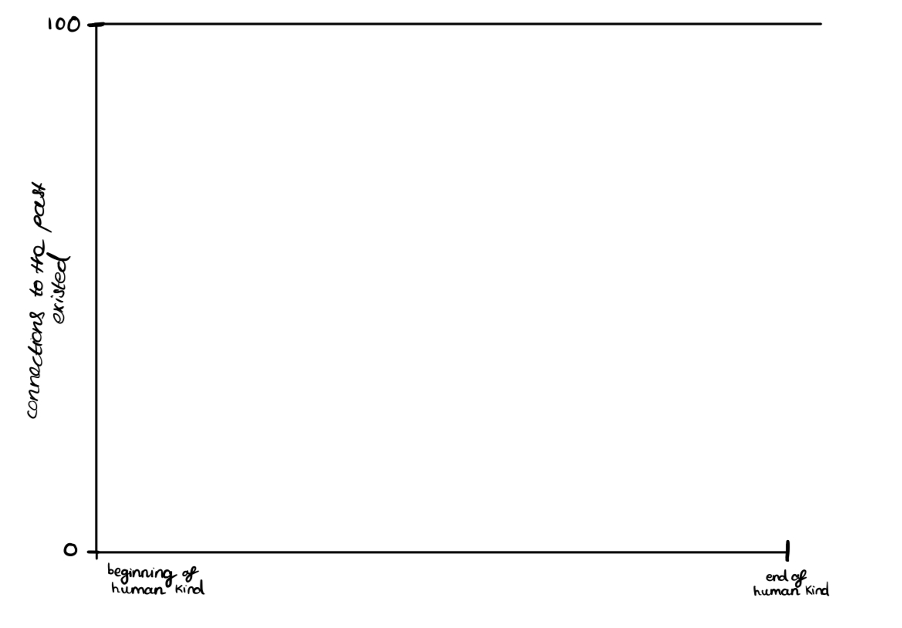
Figure 1 – an inescapable connection
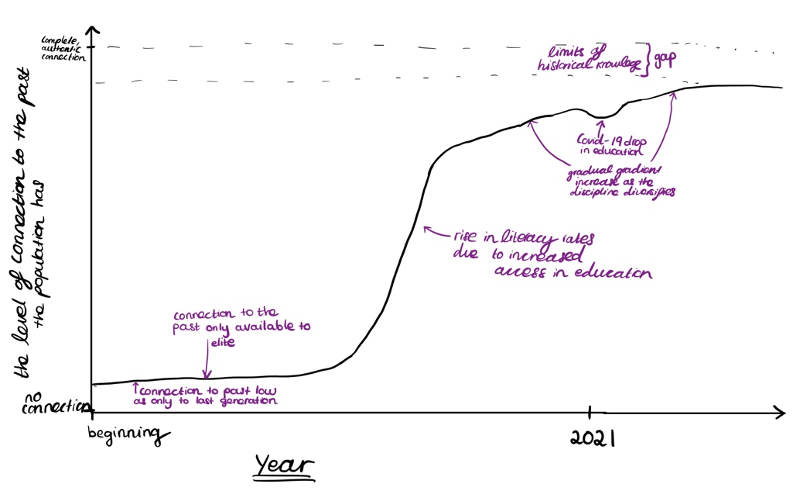
Figure 2 – how our connection to the past has changed

The inevitable connection 

Abraham Lincoln said, “Fellow citizens we cannot escape history”. By history, I understand that he meant the past. Indeed Abraham, the past is inescapable. Every single thing in our present-day world is here as a result of what happened before us. The constitutional monarchy Britain operates under being a result of the principle established through the English revolution of the importance of parliamentary power; the fact I am encouraged to wear flowery dresses whereas my brother is encouraged to wear manly suits being a product of previous generations’ mentality that to be feminine is to be seen as fragile, elegant and beautiful; the institutional and systemic racism that pervades being a scar from slavery and colonialism. The list goes on. My point is that the infrastructures and mentalities we inherit from the past explain why our present-day society operates as it does. This principle applies to every single period of time, as periods of the past do not exist as isolated bubbles, but as one very large, complex spiderweb connected to each point in time, including the present. As such, the prospect of there existing no connection to the past seems preposterous. Figure 1 illustrates this point.

So, we have a connection to the past whether we like it or not, question answered now? Wrong. A connection with the past includes an understanding of what happened, how society worked and what people at the time thought. Essentially, this is what the study of history seeks to accomplish. 

So, in this context, what is an ‘eternal present’?

Living in the eternal present means living with a lack of concern for the past, with an absence of a relationship with the past. But why is an eternal present of this kind undesirable? Howard Zinn highlighted the danger when he said:

“History is important. If you don’t know history, it is as if you were born yesterday. And if you were born yesterday, anybody up there in a position of power can tell you anything, and you have no way of checking up on it.”

If Boris Johnson were to say tomorrow in his 5pm briefing “historically, people wearing pink shoes are the carriers of viral diseases”, and we had no way of checking up on it through the study of history, Boris’ followers (and the UK at large) might unjustly turn against wearers of pink shoes e.g. by locking them inside. A silly example, sure, but true in the sense that access to the past and subsequent connection to it allows us to assess claims made in the present and not give people in positions of power the ability to implant ideas in our mind without factually grounded justification. Therefore, while a connection to the past fulfils the appetite of people who wonder “what came before us?”, it also has a practical importance that prevents disproportionate power being given to leaders and further (linking back to Figure 1) understanding the nature of the present. 

To break down the extent to which we have a connection of this type with the past, I constructed a graph (Figure 2), illustrating how the level of connection to the past has changed over time, where it stands now and the limits of this connection. 

Low levels for a long time 

For the average person 500 years ago, the principle of performing tasks as they came was an ongoing necessity. A reality riddled with war, pestilence and famine meant that a person’s everyday activities were necessary responses to the threatening conditions of their present, with little time to consider the past. Even if the average person desired to connect to the past and actively attempted to do so, they had no means of doing so beyond the limited recent history of their family passed down through folk stories and word of mouth (which has room to become myth-like, and become distorted) due to the minimal/ non-existent education and literacy rates (standing at c. 5% in 1475). Even up until 1800, the percentage of the illiterate population was c. 90%. All of this meant that access to the past and therefore a connection to the past was only available to that exclusive elite group occupying 10% of the population who could afford to ponder what happened in the past and who had the means to do so. Thus, for a very long time, the majority of people in the past had no choice but to live in an ‘eternal present’, with minimal connection to any sort of past. 

The gradient increase

These days, many have the luxury of relative comfort and the privilege of education due to developments in technology and increased income distribution. Currently, the adult literacy in the UK is edging on 100%. In 2016, the global literacy rate stood at 86.25% and only shows sign of increasing as education infrastructure is built in more communities. Furthermore, 51% of the global population uses the internet, which has endless resources for studying history. All of this leads me to say that through rising literacy, access to education and relative comfort, an education in history can be provided, allowing a great proportion of the population to look beyond the ‘eternal present’ by establishing a connection with the past. Thus, the gradient on the graph in Figure 2 increases rapidly, as access to education and literacy rose.

The short way of saying all this is:

  1. Studying history gives us access to the past
  2. Access to the past helps us understand the past
  3. Understanding the past enables us to create a connection with it
  4. More people can study history nowadays 
  5. Therefore, more people have a connection to the past.

Surely the question is answered now? No. Just studying some form of ‘history’ in a school setting or online does not mean all of ‘the past’ is understood and connected to.

The plateau

Even if we are studying history, if we are only studying certain aspects of it then our connection to the past is limited. First, the public can only establish connections with those parts of the past on the historical menu. Historians create this menu. Naturally, historians’ study historical episodes they deem ‘relevant’ or ‘interesting’. The kind of things one finds interesting is often determined by their experience, heavily influenced by their background. Thus, in the past due to the fact the opportunity to write history was only given to an elite and exclusive group of white males from the upper-class who has similar experiences and interests, the kinds of history being written suited their interests and a connection to the wider parts of the past was not achieved. However, due to increased rates of those given the opportunity to have a higher education in history, the demographic of those writing history has diversified. With this diversification comes wider interests and therefore a cumulative broader coverage of history, from different perspectives. Thus, a black and white ‘menu of history’ written by a very small demographic transforms into a more colourful one, with new connections to different pasts (displayed in Figure 3).

Figure 2 – a more colourful menu

The uncloseable gap 

The arguments thus far have been contingent on the fact that the study of history can successfully provide an objective account of the past. In fact, the ‘past’ and ‘history’ are two different things as it is nearly impossible to provide an objective account of the past, no matter how hard we may try. In his Pursuits of History, John Tosh explains part of this problem:

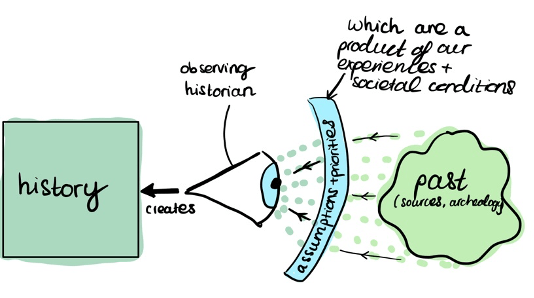
  1. A person’s values and assumptions are a product of individual experience and depend largely on societal conditions.
  2. The process of writing history requires a lot of decisions in order to get a finished product (e.g. choosing which sources to include, how to interpret sources, how one uses imagination to fill in the gaps of sources).
  3. Therefore, history can never be a completely objective account of the past

Another tendency in historical study is to create a satisfying account, with a distinct ‘beginning, middle and end’. Unfortunately, the past is not this convenient and clean; while some structuring must be done by the historian to make sense of this mess, there is a great risk of oversimplifying matters at the cost of real understanding in the process of making it a digestible story. 

Moreover, historians may start studying a period with a particular hypothesis that appeals to them, and subconsciously only select evidence that supports their hypothesis, rather than analysing the sources in a way that may refute their model. For example, for a long time there was a fitting consensus that the Roman Empire had fallen due to a long-term economic decline, which complied with modern thinking on the economy being a key decider on a state’s health. However, an architectural discovery by Georges Tchalenko revealed that late Roman villages were prosperous and there was no major economic crisis before the 5th century, forcing historians of this period to reconsider their hypothesis. While this is an oversimplification in itself, it exemplifies the idea that our contemporary assumptions and stubbornness to support hypotheses can lead to explanations of the past that are simply not true and can cloud a real understanding and thus connection to the past.

Figure 3 – history is not the same as the past

Figure 3 illustrates this process, in which a formerly green irregular shape is turned into a turquoise regular (more satisfying) square by the observing historian. The two are not the same, and while we can try to minimise this barrier by consciously aiming to reduce the influence of our assumptions in our study of past and see it on its own terms, we are mere mortals and thus our understanding is capped at a point on the graph.

A false connection

In these ways it seems no matter how hard we try; we plateau at a point of the graph. However, there is a more Orwellian view that proclaims our historical understanding can be intentionally manipulated by those who create the history, due to the way they select and frame the evidence. This is particularly harmful when it comes to education as politicians can select certain narratives to teach the population through the national curriculum. This process is illustrated in figure 5. Hitler used the History curriculum as a propaganda tool to indoctrinate the youth such that they would form views in accordance to his ideology, with a nationalistic approach. For example, the German defeat in 1918 was explained as a work of Jewish and Marxist spies who had weakened the system from within and the hyperinflation of 1923 as the work of Jewish saboteurs. Similar methods are currently being used in North Korea based on ‘the thesis of Socialist education’, and even in Britain when in 2013 Michael Gove attempted (and failed) to reform the national curriculum with the intention of focusing on ‘Island story’ to make people proud of Britain without acknowledgement of its relationships with other countries. Such a curriculum could lead to a perversely insular perspective, which fails to equip students in a globalised world. Such a threat is becoming more potent in the age of social media, where leaders can tweet misinformation about the past and reach their audience at all times. Despite the fact I established that more people are able to gain a connection to the past now through education, this process manipulates the nature of the past, creating false and potentially harmful connections, which is arguably worse than no connection at all. Where this kind of connection lies on Figure 2 is less clear, or if it even lies in the negative y-axis in which our connection through history to the past has become so manipulated, any form of an authentic one cannot exist.

figure 5 – manipulating history

What does this all mean for our connection to the past and the extent to which we live in an ‘eternal present’? Despite the monotony over the last year of ‘wake up, zoom, sleep, repeat’ that can often make us feel as though we are living in a ‘Groundhog Day takes 2020/1’, a torturous eternal present, this is temporary and (hopefully) will be over by June 21st. Even so, throughout this ‘pestilence’ we have found time to study and appreciate history, with a surge of journalists drawing back on the history of pandemics and lockdowns to teach us, allowing us to draw parallels and establish a connection with the past. This exemplifies how fortunate we are to be born into a period of time in which a connection to the past is possible through the study of history, and that the masses have an increasing opportunity to understand the past. Nonetheless, the limits of historical knowledge prevent us from establishing 100% authentic connection, and perhaps we never will, and perhaps that’s not such a bad thing. This seemingly irritating gap between the graph line and the 100% ensures the debate that characterises and livens historical study persists, as never having consensus on a question means fruitful debate can occur. However, what is more concerning is leaders weaponising the past to create dishonest and harmful connections. Not only is this a disgrace to the study of history but has potential detrimental fallout. We must monitor how our leaders are trying to use history to instil a certain narrative and perspective, appreciating the value and the dangers of establishing connections with the past.